Description
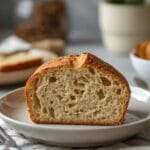
This guide focuses on practical techniques to help you coax the best out of your einkorn flour, leading to a beautifully risen loaf with an open, airy crumb. We’ll explore gentle handling, strategic folds, and proper hydration to ensure your einkorn sourdough develops that robust structure necessary for a perfect bake. Get ready to transform your einkorn baking experience and enjoy consistently excellent loaves.
Ingredients
Instructions
1. Combine Ingredients for Autolyse: In a large mixing bowl, combine the 350g einkorn flour with 280g warm water. Mix with your hands or a Danish dough whisk until no dry spots remain and a shaggy dough forms. Cover the bowl with a damp cloth or plastic wrap and let it rest for 30 minutes to 1 hour. This “autolyse” step allows the flour to fully hydrate, beginning the gluten development process. The dough will look somewhat rough and sticky at this stage.
2. Incorporate Starter and Salt: After the autolyse, add the 100g active einkorn sourdough starter and 7g fine sea salt to the dough. Using wet hands, gently squeeze and fold the starter and salt into the dough until fully incorporated. This might take a few minutes, and the dough will feel a bit messy. Continue until the salt is dissolved and the starter is evenly distributed.
3. Perform Initial Stretch and Folds (First Set): Let the dough rest for 30 minutes. Then, with wet hands, gently grab a portion of the dough from one side, stretch it upwards, and fold it over itself towards the center. Rotate the bowl a quarter turn and repeat this stretch and fold action three more times, completing one full round. The dough will start to feel slightly more cohesive.
4. Continue Stretch and Folds (Subsequent Sets): Cover the bowl and let the dough rest for another 30 minutes. Repeat the stretch and fold process (Step 3). Perform a total of 4-6 sets of stretch and folds, spaced 30-45 minutes apart, over the next 2-3 hours. As you progress, you’ll notice the dough becoming smoother, more elastic, and holding its shape better, indicating gluten development. It will feel less sticky and more manageable.
5. Bulk Fermentation: After the final set of folds, cover the bowl and let the dough continue to bulk ferment at room temperature (around 70-75 F) for an additional 3-5 hours, or until it has increased in volume by about 30-50% and shows signs of activity (small bubbles on the surface, jiggles when the bowl is gently shaken). The exact time will depend on your starter’s strength and ambient temperature.
6. Shape the Dough: Gently turn the dough out onto a lightly floured surface. Avoid deflating it too much. Perform a pre-shape by gently folding the edges towards the center to form a round or oval. Let it rest, uncovered, for 20-30 minutes. Then, perform the final shaping into your desired loaf shape (boule or batard). Place the shaped dough seam-side up into a floured banneton or a bowl lined with a floured cloth.
7. Cold Proofing: Cover the banneton with plastic wrap or a shower cap and refrigerate for 8-12 hours, or up to 24 hours. This cold proofing slows down fermentation, develops flavor, and makes the dough easier to handle for scoring.
8. Bake the Loaf: Preheat your oven to 450 F (232 C) with a Dutch oven inside for at least 30 minutes. Carefully remove the hot Dutch oven, invert the cold dough into it, score the top with a sharp blade, and bake covered for 20 minutes. Then, remove the lid and continue baking for another 20-25 minutes, or until the crust is deeply golden brown and the internal temperature reaches 200-210 F (93-99 C). Allow the bread to cool completely on a wire rack for 1-2 hours before slicing to ensure the crumb fully sets.
- Prep Time: 15-20 minutes active
- Cook Time: 40-45 minutes
- Category: bread
- Method: baking
- Cuisine: european
Nutrition
- Serving Size: 1 slice
Keywords: einkorn, sourdough, bread, baking, gluten, fermentation, whole grain, homemade, artisan, ancient grain